Ever asked yourself, “Can I sue my gym?” after a treadmill sends you flying or a cable snaps mid-rep? I’ve been there, and I know the frustration of dealing with an injury that wasn’t my fault.
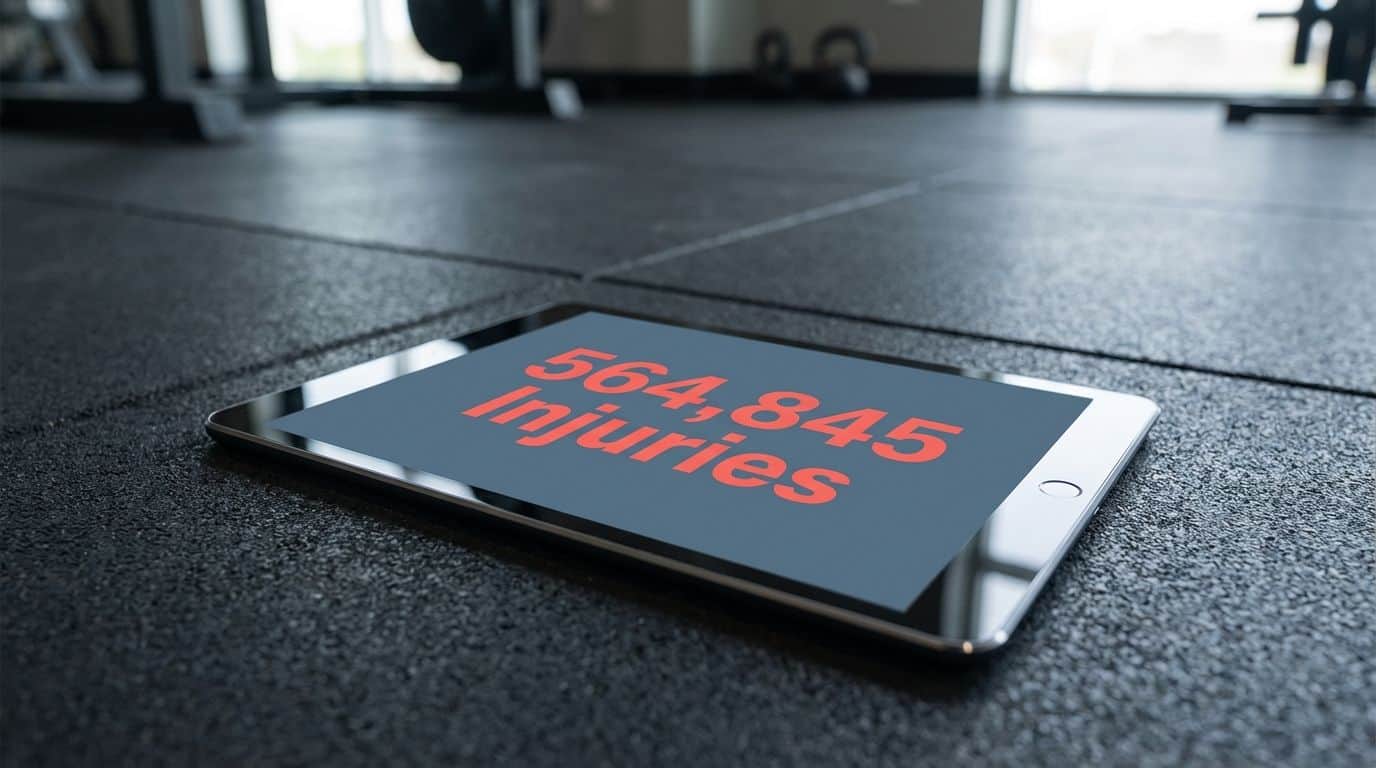
You aren’t alone in this. In fact, exercise equipment injuries are skyrocketing, with recent data showing over 564,000 incidents in 2024 alone.
Most guys think signing that waiver means they have zero rights, but that’s often just what the gym wants you to think.
I’m going to walk you through exactly how I determine if a gym is liable, what evidence actually matters, and the specific laws that protect us.
So, grab a protein shake, and let’s get into the details that could help you cover those medical bills.
Key Takeaways
You can still sue: Courts in states like California and New York often rule that liability waivers cannot protect gyms from gross negligence or reckless misconduct, even if you signed a release.
Injury numbers are rising: According to the National Safety Council, exercise equipment injuries hit 564,845 in 2024, with men making up nearly 60% of weightlifting accidents.
Know your contract rights: The Federal Trade Commission sued L.A. Fitness in August 2025 for making cancellations “exceedingly difficult,” highlighting new scrutiny on predatory contracts.
Gather evidence immediately: Use your phone to snap photos of the hazard and get contact info for witnesses; metadata on these files proves the exact time and date of the negligence.
Compensation is real: A successful personal injury claim can cover more than just bills; for example, an ACL surgery can cost up to $50,000, and you can seek recovery for those costs plus lost wages.
Table of Contents
Common Reasons to Sue a Gym
Stuff goes wrong at the gym—that’s part of the game, right? But there is a huge difference between dropping a weight on your own toe and a machine collapsing because the staff ignored a maintenance schedule.
I’ve learned that legitimate legal cases usually stem from specific failures by the gym management, not just bad luck.
What injuries can result from faulty gym equipment?
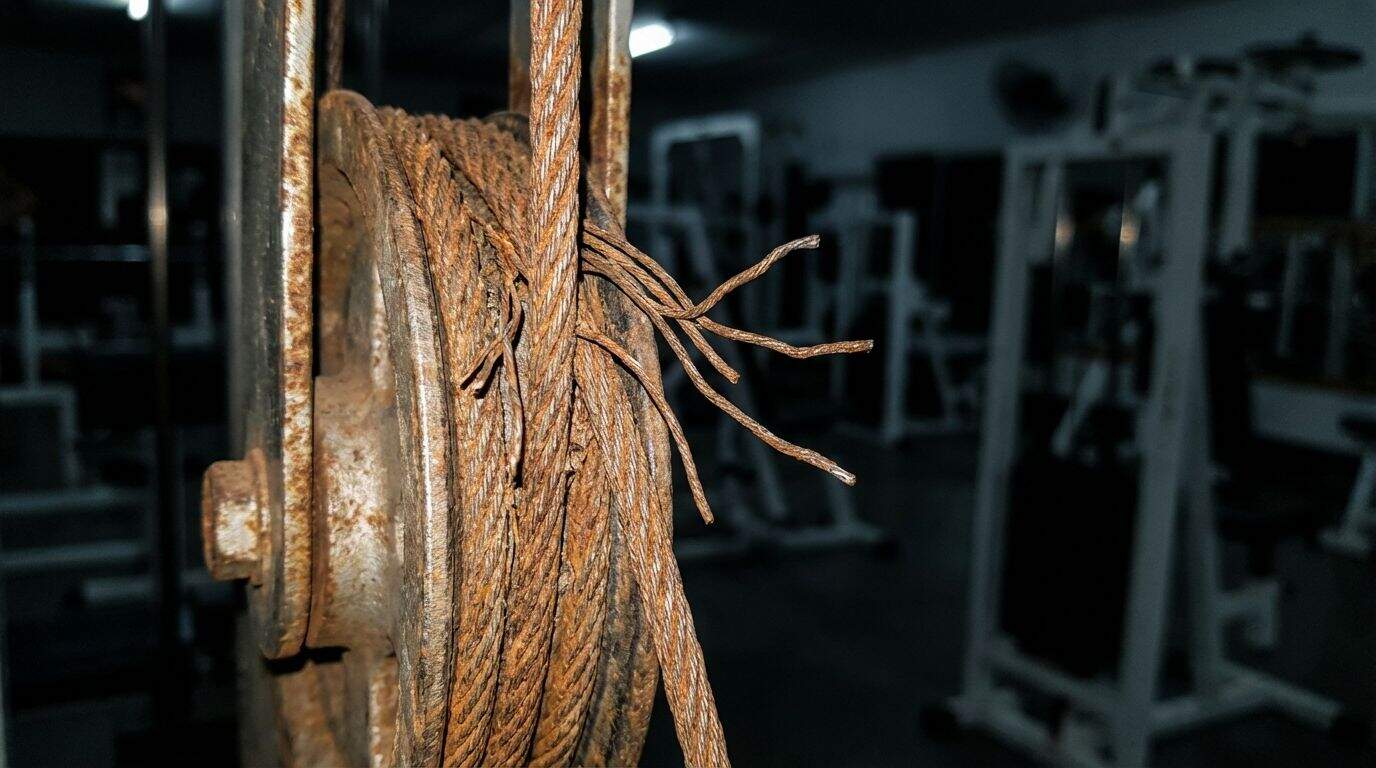
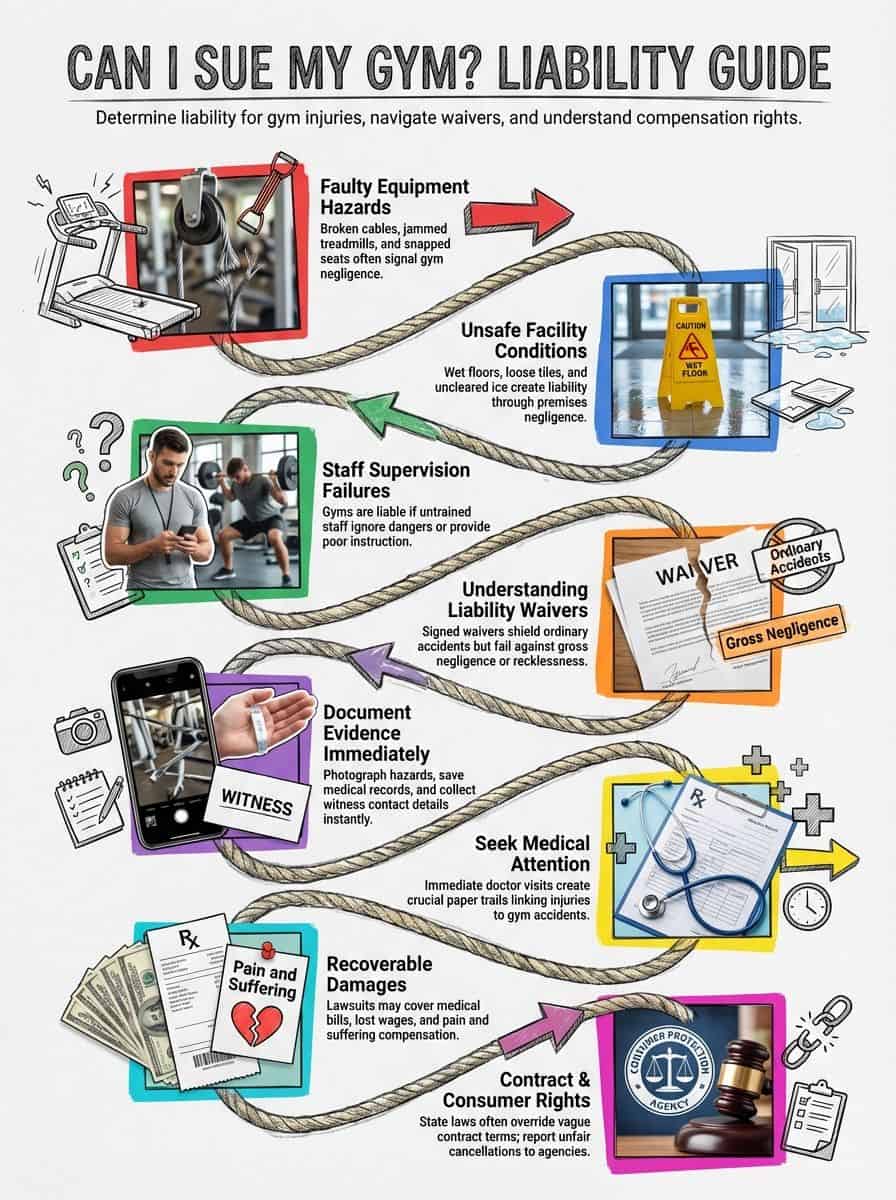
Broken cables, cracked pulleys, and wobbly benches are serious hazards. I saw a report from ZipDo indicating that faulty equipment and improper technique account for a massive chunk of the 564,845 injuries reported in 2024.
My gym story? I watched a guy tear his rotator cuff because a cable machine hadn’t been serviced in months. Malfunctioning treadmills are another classic culprit; if the belt surges unexpectedly, it can throw you backward, leading to severe friction burns or head trauma.
A busted weight bench or a missing safety pin can lead to catastrophic results like spinal cord damage or Traumatic Brain Injury (TBI). Negligence with maintenance creates hidden traps for even the most experienced lifters.
If you get hurt because a machine failed, you need a pro who understands product liability. For guys near Illinois, I’ve heard good things about this Evanston personal injury lawyer.

I never thought a rusted pulley could turn a standard chest day into a $20,000 surgery, but that is the reality of ignored maintenance.
How do slippery floors or unsafe conditions cause harm?
Slippery floors are the silent assassins of the gym world. I’ve seen puddles near the locker rooms and sweat slicks by the squat racks that sit uncleaned for hours.
If you hit the deck, you risk everything from a torn meniscus to a concussion. It’s not just about being clumsy; gyms have a legal duty to exercise reasonable care. This means they must inspect the premises regularly and fix hazards promptly.
Courts look at what a “reasonable person” would do. If a pipe was leaking for three days and the staff just put a cone over it without fixing the leak, that borders on negligence.
This applies outside the workout floor too. If the parking lot is an ice rink because they didn’t salt it, the gym could be liable for your slip and fall before you even swipe your card.
When is a gym responsible for lack of supervision or training?
A gym drops the ball if its staff ignores members who are clearly endangering themselves or others. I remember seeing a novice trying to bench heavy without a spotter while three trainers stood around chatting nearby.
If a personal trainer gives poor instructions—like telling you to lift way beyond your max—and you blow out a disc, that is on them. Data shows that men are involved in 60% of weightlifting injuries, often due to ego lifting that staff should intervene in.
I’ve read about cases where members complained about a dangerous patron, and the staff did nothing until a fight broke out or someone got hurt. That isn’t just lazy; it can be considered gross negligence.
Even with a waiver, laws often prevent gyms from dodging responsibility when their own staff is unqualified or reckless. Pain and suffering compensation becomes a real possibility in these scenarios.
What membership disputes or contract breaches can lead to lawsuits?
If my gym refuses to cancel my membership after I’ve followed their rules, I’m ready to fight back. L.A. Fitness faced a massive lawsuit from the Federal Trade Commission in August 2025 for allegedly trapping members in subscriptions they couldn’t escape.
Some gyms break contract law by failing to provide the services you paid for, like closing the pool for months without a refund. This can escalate to debt collection harassment if they keep charging you after you quit.

| State | Cooling-Off Period | Key Statute |
|---|---|---|
| California | 5 Days | Civil Code § 1812.85 allows cancellation within 5 days for a full refund. |
| New York | 3 Days | General Business Law § 624 mandates a 3-day right to cancel. |
| Illinois | 3 Days | Physical Fitness Services Act protects your right to back out quickly. |
If your gym sends unpaid fees to a collector illegally, they might be violating the Fair Debt Collection Practices Act. I always suggest checking with the Better Business Bureau (BBB) if a gym starts playing games with your bank account.
Understanding Assumption of Risk
Assumption of risk is the legal concept that says, “You knew lifting heavy metal objects could be dangerous.” It’s the gym’s favorite defense, but it doesn’t cover everything.
What does assumption of risk mean?
When I walk into a gym, I accept that I might drop a weight or pull a muscle. That is “primary assumption of risk.”
However, this doesn’t mean I accept the risk of the ceiling collapsing or a machine snapping in half. There are two main types you need to know:
- Express Assumption: This is the waiver you signed. You explicitly agreed to accept certain risks.
- Implied Assumption: You didn’t sign anything for this specific risk, but it’s obvious (like the risk of falling while running on a treadmill).
States like Louisiana follow Comparative Negligence rules. This means if I am 50% at fault for my injury because I was using the machine wrong, my payout gets cut in half.
I had a buddy who cut his hand on a rusted bar. The insurance company tried to argue assumption of risk, but because the risk (tetanus from rust) wasn’t inherent to lifting weights, he had a case.
How does assumption of risk affect gym injury claims?
This defense can kill a lawsuit fast if you aren’t careful. I saw a friend lose a case because he admitted he knew the deadlift platform was slippery but lifted anyway.
If you sign a general liability waiver, insurance companies will wave it in your face immediately. They argue that you accepted the danger just by swiping your badge.
However, you cannot assume a risk you didn’t know about. If a gym employee waxed the floor and didn’t put up a sign, that is a hidden hazard, not an assumed risk.
Attorneys fight these battles daily. In many Southern states, the “open and obvious” defense is strong, but it rarely protects gyms from their own reckless disregard for safety.
Types of Liability Waivers Used by Gyms
Gyms love paperwork. I’ve signed dozens of these forms, and they all try to say the same thing: “If you get hurt, it’s not our fault.” But knowing what you actually signed can change the game.
What are general liability waivers?
A general liability waiver is the gym’s first line of defense. I’ve seen these included in every digital sign-up flow.
These documents list the standard risks associated with working out. They usually include an “Indemnification” clause, which is a fancy way of saying you promise to pay for their legal trouble if you sue them.
However, these waivers are designed for ordinary accidents. They protect the gym if you trip over your own shoelaces, but they often fail when the gym creates the danger itself.
What are negligence waivers?
Negligence waivers are more specific. They try to stop me from suing even if the gym’s employees make a mistake.
A solid waiver will list specific activities, like “using the sauna” or “Olympic lifting.” If I sign one that specifically mentions the risk of the sauna overheating, I might be out of luck if that happens.
But here is the catch: courts in many states hate vague waivers. If the language is confusing or buried in fine print, a judge might toss it out.
“A waiver is a shield, not a suit of armor. It has cracks.”
Personal injury lawyers know how to find these cracks. If the font was too small or the terms were hidden, the statute of limitations might be the only thing stopping you.
What limits do waivers have in legal claims?
This is where it gets interesting. I’ve found that waivers almost never protect a gym from gross negligence.
In California, the famous case of City of Santa Barbara v. Superior Court established that you cannot sign away your right to sue for gross negligence. If the gym knew a cable was fraying and let people use it anyway to save money, that waiver is likely worthless.
Similarly, New York’s General Obligations Law § 5-326 often voids waivers for places of recreation where you pay a fee. Gyms try to argue they are “instructional” to get around this, but it’s a weak argument.
If the condition was clearly dangerous and ignored, legal counsel can often pierce that waiver and get you into court.
Steps to Take if You Want to Sue Your Gym
If you get hurt, your actions in the first hour matter more than anything else. I always tell guys to treat a gym injury like a car accident: document everything.
How should you document the incident and gather evidence?
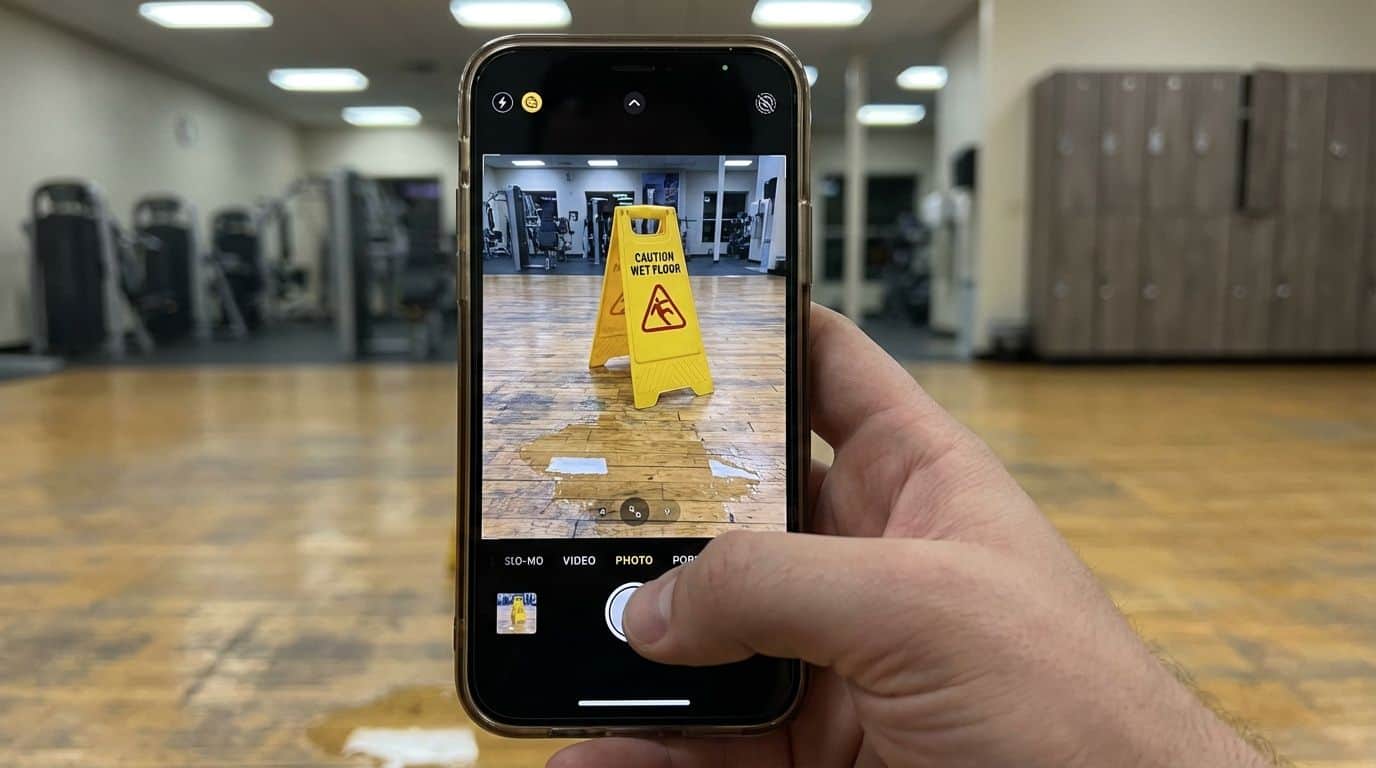
I pull out my phone immediately. I don’t just take a photo of my injury; I take wide shots of the area, the equipment, and any lack of “Caution” signs.
The metadata on these photos is crucial—it proves exactly when the hazard existed. I also open my voice memo app and dictate what happened while it’s fresh.
I grab names and phone numbers of anyone who saw it. Witnesses disappear fast. If I can, I get them to text me a brief description of what they saw right then and there.
I also request the incident report from management. I take a photo of it before handing it back. Never trust them to keep a copy for you.
Why is it important to seek medical attention for injuries?
I go straight to the doctor, even if I think I can “walk it off.” Adrenaline hides pain, and a gap in treatment is the number one reason claims fail.
I ask the doctor for a “narrative report” that specifically links my injury to the gym accident. If I wait two weeks, the insurance company will say I hurt my back carrying groceries, not squatting on their broken rack.
These records create a paper trail for medical expenses and lost wages. Without them, you have zero leverage.
How do you review your gym membership contract?
I log into my member portal and download my specific contract. I look for the “Liability” section, but I also look for “Force Majeure” and cancellation clauses.
In states like New York, contracts can’t exceed 36 months. If yours does, the whole thing might be void.
I check for the cooling-off period. If I just signed up and got hurt immediately, I might be able to cancel under state law (3 days in Illinois and Tennessee, 5 days in California) and get my money back while I figure out the legal side.
When should you consult a qualified attorney?
If the injury required surgery or kept me out of work, I call a lawyer. Most reputable firms, like Florin Roebig, offer free consultations, so it costs nothing to ask.
A good attorney will find things I miss, like maintenance logs or previous lawsuits against the same gym chain. They know how to deal with insurance companies that try to lowball you.
If the accident involved unsafe conditions management ignored, getting legal help is the only way to level the playing field against a corporate legal team.
Can You Sue if You Signed a Waiver?
I signed the waiver. You signed the waiver. We all did. But I’ve learned that piece of paper isn’t the final word.
Courts in Texas and California look closely at whether the waiver was fair. If it was hidden in a 50-page digital scroll, it might not be enforceable.
More importantly, waivers cannot cover gross negligence. If the gym owner was drunk on the job or if they removed safety guards from machines to make them “look cooler,” that waiver is trash.
Also, parents cannot sign away the rights of their children in many states. If your kid got hurt at the gym daycare, that waiver you signed likely doesn’t stop a lawsuit.
What Compensation Can You Get in a Gym Lawsuit?
If you win, it’s not just about a “sorry.” The financial impact of a gym injury is real, and the compensation should match it.
Can you recover medical expenses?

Absolutely. I’m talking about every dime. An ACL reconstruction surgery in 2025 can cost between $20,000 and $50,000 if you don’t have great insurance.
I collect every receipt: co-pays, crutches, Uber rides to physical therapy, and prescription costs. In a lawsuit, the goal is to make you “whole” again financially.
Even with a waiver, if the gym was negligent, they are on the hook for these bills. Documentation is your best friend here.
Is lost wages compensation possible?
If I can’t work, I can’t pay rent. Lost wages compensation covers the income I missed while recovering.
I use my W-2s or 1099s to prove what I normally make. If the injury causes a permanent disability that lowers my earning potential forever, I can sue for “loss of future earning capacity.”
Doctor’s notes are essential. If the doc says “no lifting over 10 lbs” and my job involves construction, that note proves why I missed three months of paychecks.
What about pain and suffering damages?
This is for the non-economic stuff. Pain and suffering covers the sleepless nights, the depression from not being able to work out, and the physical agony.
Lawyers often use a “multiplier method,” taking your medical bills and multiplying them by 1.5 to 5 times to calculate this amount.
In California, you can claim emotional distress if the incident was particularly traumatic. If a machine failure left you with a permanent scar or limp, the jury will factor that into the award.
How Will Gym Lawsuits Change in 2025?
The landscape is shifting fast. In August 2025, the FTC sued the operators of L.A. Fitness, alleging they trained staff to purposely make cancellation impossible.
While the federal “Click to Cancel” rule was blocked by an appeals court in July 2025, the pressure is on. I expect to see more states passing their own versions of these laws to protect consumers.
If you are stuck in a predatory contract or got hurt because a gym cut corners to save cash, now is the time to speak up. The courts and the Federal Trade Commission are watching closely, and the days of gyms bullying members are coming to an end.
If my gym tried these tactics today, I wouldn’t hesitate to file a complaint and call an attorney. You shouldn’t either.
People Also Ask
How do I know if my gym is responsible for my injury?
If the gym ignored a known hazard—like a frayed cable or a spill someone reported earlier—they likely failed their “duty of care” under US premises liability laws. I always tell guys that if the gym’s negligence, rather than your own lifting form, caused the accident, you have a solid case.
What should I do right after getting hurt at the gym?
First, get medical attention to create an official record, then file a formal “incident report” with the manager before you walk out the door. I can’t stress this enough: do not apologize or admit fault on that form, because the insurance company will definitely use those words against you.
Can I still sue if I signed a waiver before joining?
Yes, because while those waivers cover ordinary mishaps, I know for a fact they rarely protect gyms from lawsuits involving “gross negligence” or reckless disregard for safety.
What kind of proof helps most in these cases?
Photos of the hazard are essential, but I’ve found that demanding the preservation of surveillance video is your strongest weapon since it offers unbiased proof. You should also grab the phone numbers of any witnesses immediately, as their statements can confirm the gym knew about the problem.
References
https://www.shouselaw.com/ca/blog/injured-by-faulty-equipment-at-a-gym/ (2025-04-11)
https://1800lionlaw.com/sue-a-gym-for-injuries-from-faulty-equipment/
https://www.rushinjurylaw.com/premises-liability-accidents-in-gyms-and-fitness-centers/ (2024-11-11)
https://rodenlaw.com/blog/gym-injury-liability/
https://www.shreveportlawyer.com/blog/what-does-assumption-of-risk-mean/ (2023-08-17)
https://kellumlawfirm.com/personal_injury/understanding-assumption-of-risk-in-personal-injury-cases/
https://sparkmembership.com/liability-waiver-for-gym-use/ (2022-11-10)
https://www.amundsendavislaw.com/alert-LiabilityWaiversAGymOwnersShieldAgainstLawsuits
https://mccunewright.com/blog/2016/10/suing-a-gym-when-youve-signed-a-waiver/ (2016-10-31)
https://www.rothenberglawnj.com/blog/can-i-sue-a-gym-for-an-injury/
https://www.jameslawsc.com/blog/should-i-sue-if-i-sustained-an-injury-in-a-gym-in-south-carolina/
https://zanerhardenlaw.com/blog/sue-gym-injuries/ (2022-09-19)
https://www.tbmlawyers.com/blog/can-you-sue-after-signing-waiver
https://bufflaw.com/news/can-you-sue-after-signing-a-waiver/ (2025-06-16)
https://cutterlaw.com/faqs/can-you-sue-gym-for-injuries/
https://walkertexaslawyer.com/gym-equipment-malfunction-injury-how-to-prove-negligence/ (2025-10-16)
https://hortonmendez.com/gym-injuries/ (2025-09-10)